
A STORY IS TOLD.
Once upon a time, a rat realized there was a trap at the entrance of the granary. It was greatly disturbed as it couldn’t access the food. Seeking help, it went to the chicken and said, “Could you please come and help me remove the trap at the granary’s door?” The chicken replied, “That’s not my concern.”
The rat, feeling helpless, moved on to seek assistance from the pig. “Kindly Mr. Pig, help me remove that trap from the granary’s door,” pleaded the rat. The pig retorted, “I don’t pass through that door. It’s your problem since you use it. I’m busy.”
Undeterred, the rat decided to ask the cow for help. “Hello dear cow,” said the rat, “I’m in desperate need of your assistance. Can you help me remove the trap from the entrance of the granary?” The cow responded, “Mr. Rat, you’ve been taking all my milk from the granary, and now you seek my help? You won’t enjoy my milk anymore. Since I don’t use that door, I can’t help.”
With a heavy heart and an empty stomach, the rat left the cow, feeling sad and hungry.
In the following nights, a man from the nearby hut heard the trap catch something. He called his wife from the kitchen, saying,

“Go and check the trap.” As the woman approached, she was bitten by a snake caught in the trap. She screamed for help. The man rushed to her aid, but the snake’s tail lashed out, biting him as well.
In an effort to help his wife, the man rushed her to the hospital where she was hospitalized. The next day, he slaughtered a chicken to prepare a meal for his wife. Tragically, he discovered that his wife had passed away. He informed their family members and friends, who gathered at their home.
During the mourning period, the man decided to slaughter a pig as a gesture of hospitality for the mourners. As they gathered for the burial, the man spoke up. “No one will take care of this cow anymore. Let the mourners have some meat as we remember and celebrate the life of my wife.”
And so, all the animals, and even the one who had set the trap at the granary, faced their demise.
GOOD SAMARITAN. (Luke 10:29-37)
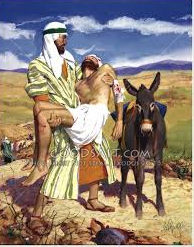
But the man was anxious to justify himself and said to Jesus, ‘And who is my neighbour?’In answer Jesus said, ‘A man was once on his way down from Jerusalem to Jericho and fell into the hands of bandits; they stripped him, beat him and then made off, leaving him half dead. Now a priest happened to be travelling down the same road, but when he saw the man, he passed by on the other side. In the same way a Levite who came to the place saw him, and passed by on the other side.
But a Samaritan traveler who came on him was moved with compassion when he saw him.
He went up to him and bandaged his wounds, pouring oil and wine on them. He then lifted him onto his own mount and took him to an inn and looked after him. Next day, he took out two denarii and handed them to the innkeeper and said, “Look after him, and on my way back I will make good any extra expense you have.”Which of these three, do you think, proved himself a neighbour to the man who fell into the bandits’ hands?’He replied, ‘The one who showed pity towards him.’ Jesus said to him, ‘Go, and do the same yourself.’
Reflection/Sharing
- Living the Gospel Beyond Words:
We are called not only to read and preach the Gospel, but to embody its teachings through actions that reflect mercy and compassion.
- “I Desire Mercy, Not Sacrifice”
This principle emphasizes being present with others in their vulnerabilities, offering qualities like love, peace, kindness, care, honesty, and concern. It’s about helping people in their lowly nature rather than asserting authority over them.
- A Continuous Question:
Always ask the question, “What can I do for others?” This mindset encourages us to seek opportunities to be of service and contribute positively to the lives of those around us.
- Philippians 2:3-5:
These verses underscore the significance of humility, encouraging us to prioritize others and their interests. Acting without jealousy or vanity, we should adopt the mindset of Christ Jesus.
- Priests and Religious Role:
Although as priests and religious, we symbolize pouring out oil and wine on the altar for others’ healing, there’s a danger of becoming too engrossed in our schedules and missing the everyday opportunities to help those in need.
- Strangers and Samaritan Woman:
Even those unfamiliar with faith can exhibit compassion, much like the Good Samaritan. This illustrates that our duty to our neighbors should surpass mere religious practice.
- Neglecting Neighbors:
As Christians, we sometimes ignore our duty to our neighbors and appear virtuous during worship, leaving them to be assisted by seemingly unexpected sources – even someone considered an “enemy.”
- Disciples’ Reaction vs. Jesus’ Response:
While the disciples tried to shield Jesus from disturbances, Jesus himself consistently prioritized helping his people, demonstrating a readiness to serve regardless of inconvenience.
- The “Doesn’t Concern Me” Mentality:
Dismissing the concerns of others with the attitude of “It doesn’t concern me, why be disturbed” contradicts the compassionate and sacrificial nature of Christ’s teachings.
The story serves as a reminder of the importance of compassion and how our actions can have far-reaching consequences.
Let have compassion
In this narrative of good Samaritan, it could be possible that the Levite and the priest who passed the dying man in need of help, were more in need than the physically injured man.
Reflect and meditate on the transformative power of living the Gospel, going beyond superficial religious acts to embody mercy, humility, and a willingness to help others–mirroring the actions of Christ himself.